The Caine's first minesweeping operation
The Caine Mutiny Court-MartialThe Caine's first minesweeping operation took place in the China Sea seventeen days before the end of World War II. It briefly gave the old ship the dangerous work its equipment had been meant to do, then ended when a fuel-pump failure made it unsafe to continue. For Willie Keith, the morning also overturned a private assumption: the minesweeping gear was not useless clutter, and the Navy did, in fact, know how to do this work.
Context and Expectations
By early 1944, the major Allied turning points at Guadalcanal, El Alamein, Midway, and Stalingrad were past, Italy had surrendered, and the balance of industrial power favored the Allies. Such a broad historical view offered little comfort to Willie. On a New Year’s Eve watch aboard the Caine, he imagined the war against Japan as a long, punishing advance across island strongholds, with mines and shore fire awaiting the fleet. The strategic picture that later historians could describe as bright remained, to him, a confused and ominous prospect.
Willie had not yet learned to interpret his own service through the scale of later histories. The war’s battles seemed diffuse and exhausting rather than dramatic; only in later years, he thought, might he recognize their historical stature. That gap between immediate experience and retrospective understanding gives the minesweeping operation its particular weight. This was not a celebrated fleet victory, but an ordinary assignment that suddenly made the danger and purpose of the Caine’s work unmistakable.
The First Mines and the Formation
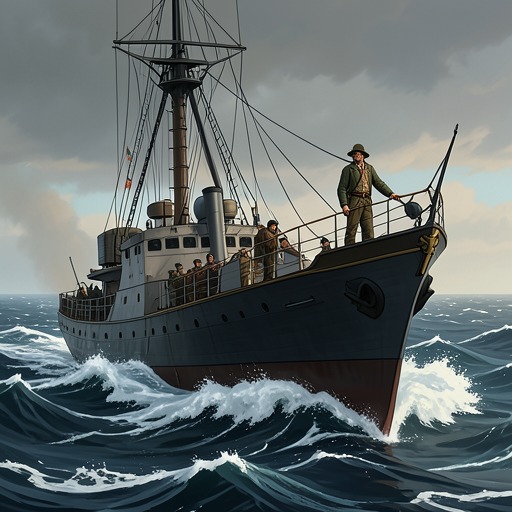
The minesweepers advanced in a double line extending five miles across the China Sea. The sun was low in the east as they moved cautiously over shallow water into the minefield. A mine surfaced in the Caine’s wake: a large, rusty, horned sphere. Tom Keefer, excited by the discovery, ordered a dye marker dropped, while signalmen raised the warning flag. A submarine chaser approached and fired on the mine with machine guns; its explosion sent a high column of spray into the air. Mines began appearing across the formation, their positions marked in the water.
The Caine was in the second line, so its crew watched the water ahead as the ships pressed on. Within a minute, another mine appeared directly in the ship’s path. Keefer circled the bridge and issued contradictory maneuvering orders as the Caine bore down on it and the guns fired. The mine disappeared in an explosion when the ship was within a hundred feet. Lookouts then spotted another mine to port, and the Caine encountered two more almost at once. For about five minutes the bridge was in confusion, as successive threats demanded immediate attention.
The first encounter did not remain an exceptional burst of alarm. After the Caine had swept seven mines and exploded about half a dozen, the work began to seem manageable, even to its nervous captain. His confidence swung toward overconfidence: he brought the ship close to a couple of mines to fire on them, frightening Willie. The operation thus shifted from surprise to routine, but routine did not remove the risk. The captain’s increasingly casual handling of the ship made the same mines feel more threatening, not less.
What the Work Revealed
Before the operation, Willie had come to believe that the Caine was fated never to sweep a mine. Its complicated equipment on the fantail seemed to him like so much unused gear, and he had treated the minesweeping manual as another book in the safe with little practical value. Seeing the mines appear, and watching the equipment do its work, corrected that view. The paravanes ran below the level of anchored mines; their cutting cables severed the moorings. The mines were real, the equipment served a real purpose, and the ship’s long preparation was not merely ceremonial.
That discovery also changed Willie’s view of the Navy. He had felt uneasy shame at recognizing that the institution might know what it was doing, because that recognition contradicted his habitual skepticism. His surprise was not a claim that the service was infallible; the operation itself showed how quickly confidence could become carelessness. Instead, the morning made the Caine’s unglamorous equipment and training legible as practical tools, while leaving the officers responsible for using them prudently.
Withdrawal and Aftermath
The Caine’s active minesweeping career was short. Just as Willie was beginning to enjoy the perilous work, the number-one boiler’s fuel pumps failed, reducing the ship’s speed to twelve knots. In the drifting minefield, that loss of maneuverability put the long ship below the required safety margin. The officer in tactical command ordered the Caine out of the line and back to Okinawa. An auxiliary minesweeper moved forward to fill its place, while the Caine turned away. Ed Keggs, aboard the USS Moulton in the next position, waved to Willie and sent a joking blinker message suggesting that he might sabotage his own pumps to escape the assignment.
On the return, the Caine encountered one more mine, floating miles behind the sweepers. Willie spotted it through binoculars and watched as gunfire struck around it before it exploded. The moment closed the ship’s wartime minesweeping effort without giving the crew any immediate knowledge that the war was nearly over. The Caine reached Buckner Bay, where it had to wait for repair support; an official letter said the tender could not accommodate it alongside until late August and directed Keefer to make repairs with supplied materials as best he could. The ship remained at anchor, gathering rust and barnacles.
Later, at the Caine’s decommissioning, Willie described the ship as obsolete and damaged, recalled its hundreds of thousands of miles of dull escort duty, and told the crew that it had swept six mines in the whole war. His speech treats this modest record not as proof of failure but as evidence of necessary service: the celebrated operations fixed the time and place of victory, while ships like the Caine performed the less prominent work that helped make victory possible. The first minesweeping operation therefore marks both a literal encounter with the ship’s intended purpose and a larger correction in how Willie understands ordinary naval duty.